Range Rover built its reputation by combining luxury with the shape and capability of an SUV. Its new electric grand tourer abandons the familiar silhouette – and tests how far one of the industry’s strongest names can stretch.
Every production Range Rover has carried the same basic visual promise: it sits higher than an ordinary car.
The new Range Rover GT breaks that pattern.
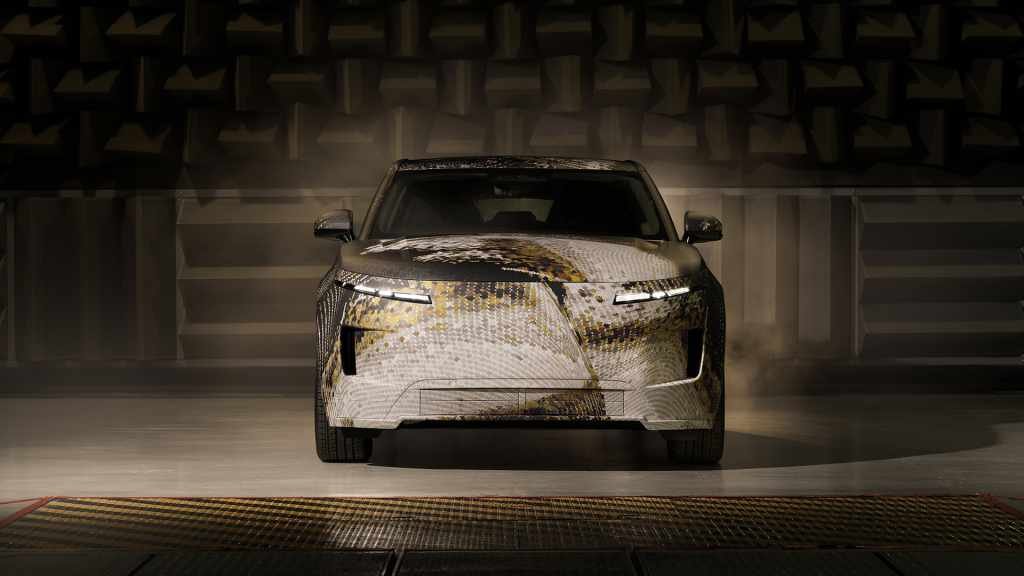
Revealed in prototype form on July 22, the fifth member of the Range Rover family is a low, four-door grand tourer with a sweeping roofline, long-distance ambitions and battery-electric power. Range Rover calls it the most car-like vehicle the brand has ever produced.
That description is more significant than any performance figure.
For the first time, Range Rover is asking customers to separate the name from the type of vehicle that made it famous.
The GT will initially arrive as a fully electric model, with a full hybrid version planned later in its lifecycle. It will be built at JLR’s Halewood plant in the United Kingdom on the company’s Electrified Modular Architecture, known as EMA. Prototype testing is now approaching its final stages, with a full reveal expected later in 2026 and the production car due to reach the road in 2027.
The unanswered question is whether Range Rover has created a genuinely new kind of luxury car – or simply placed a powerful badge on territory already occupied by Jaguar, Porsche and the traditional grand-touring establishment.
What Range Rover Has Actually Revealed
The first official preview is deliberately incomplete.
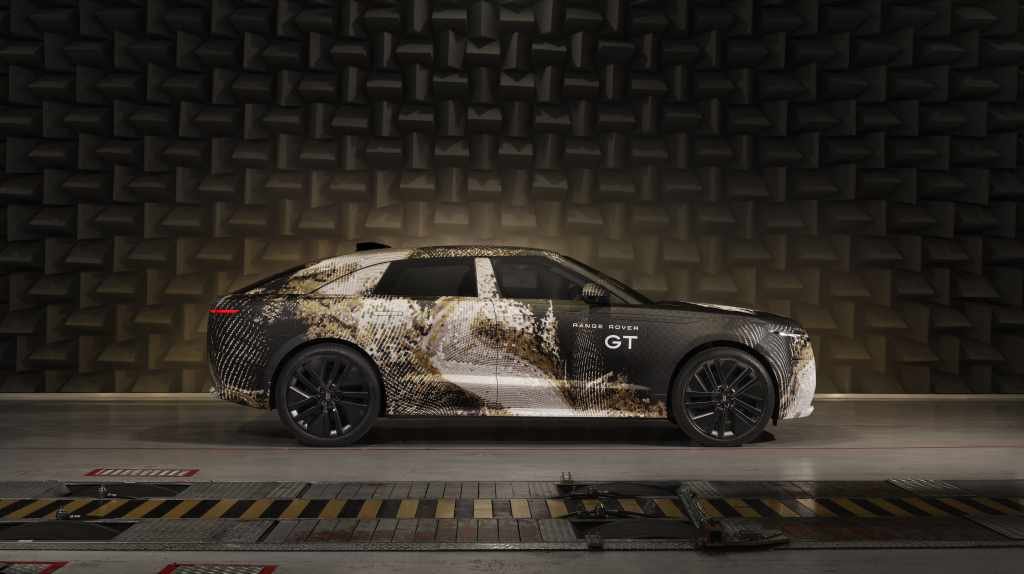
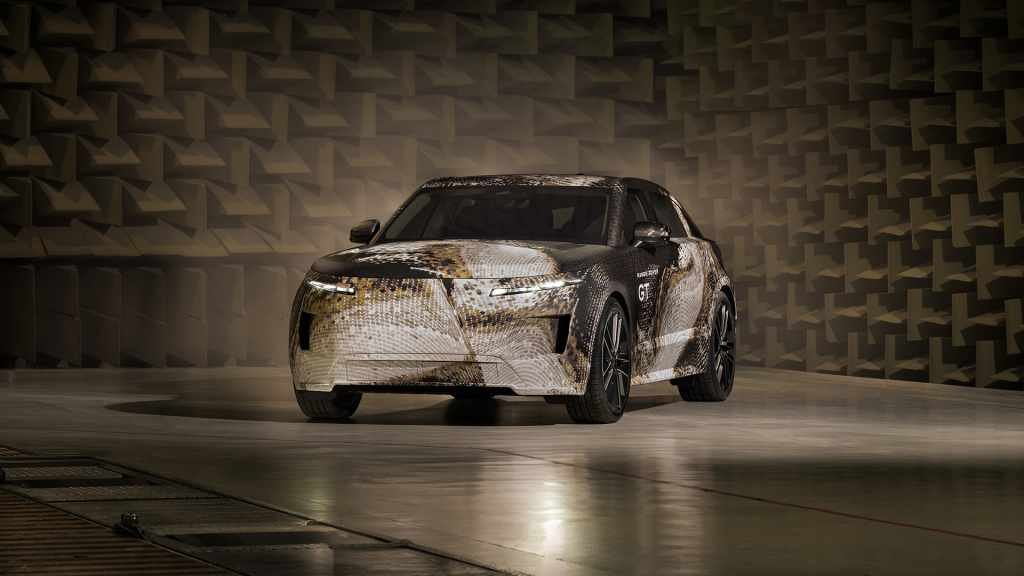
Range Rover has not announced the GT’s power output, battery capacity, driving range, charging speed or price. The exterior remains hidden beneath camouflage, and the company has released only selected views of the cabin.
What is visible suggests a vehicle with much lower, more elongated proportions than the Range Rover, Sport, Velar or Evoque. The roof arcs downward toward the rear, the wheels sit close to the corners and the body avoids the upright tail normally associated with an SUV.
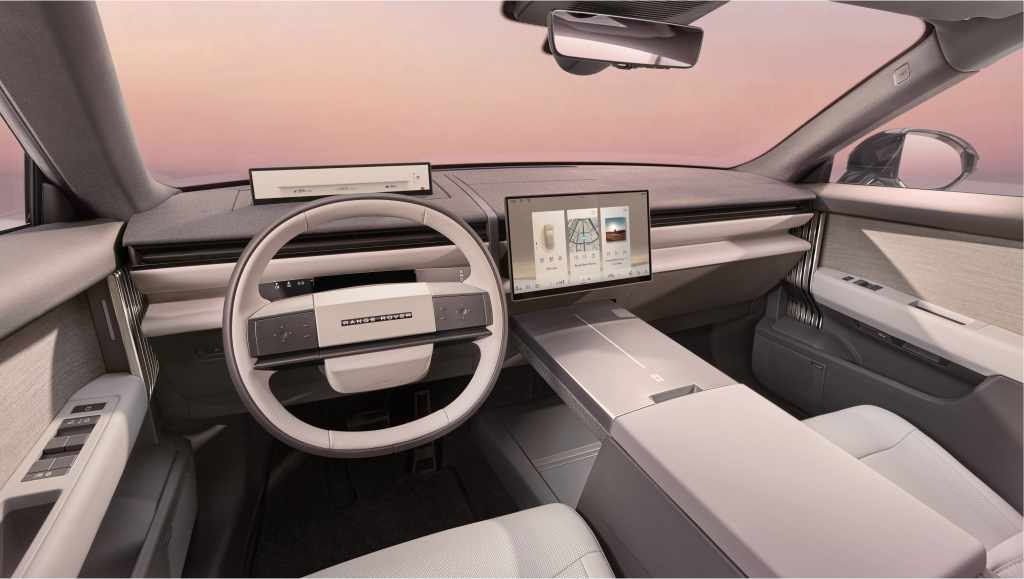
The cabin follows the same reductionist approach.
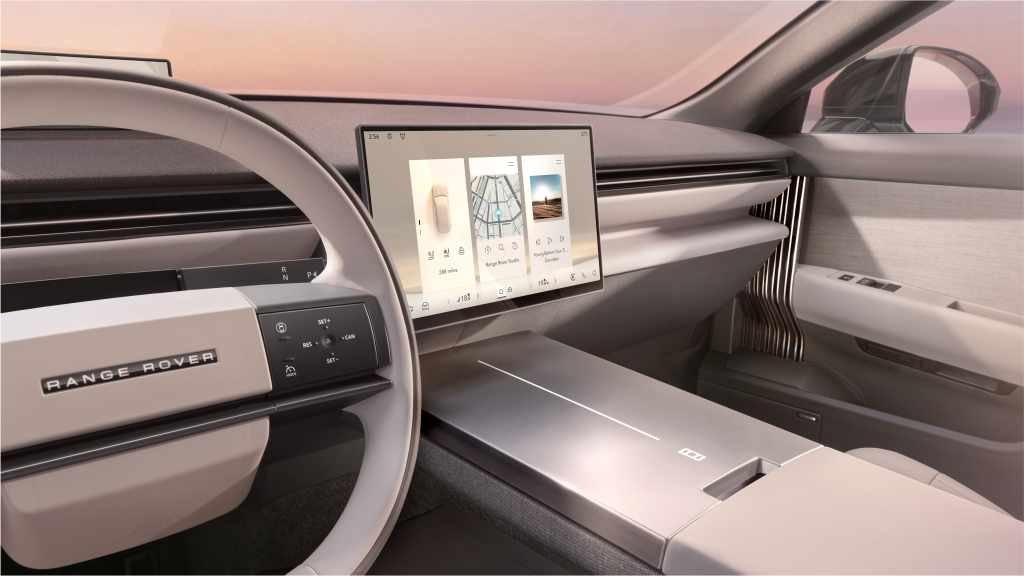
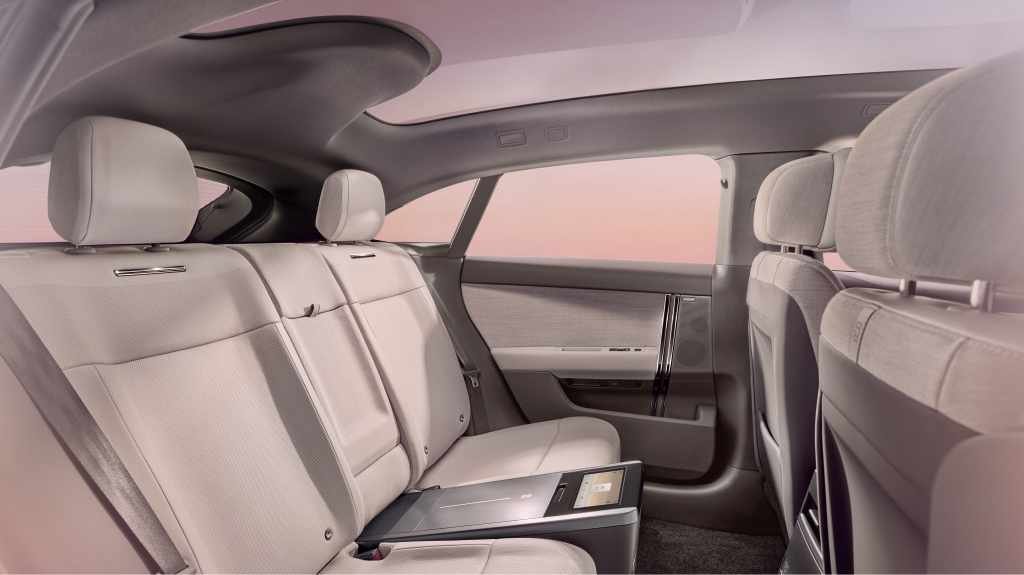
A narrow driver display replaces a conventional instrument cluster, while a single central screen manages the primary vehicle functions. A concealed air vent runs across the dashboard, and a woven textile hides speakers within the interior architecture. Range Rover also claims class-leading second-row legroom, indicating that the GT is being developed as a true four-seat luxury car rather than a two-door sports model with occasional rear accommodation.
The presentation is calm, spacious and expensive-looking.
It also leaves many of the important questions unanswered.
Range Rover Is Becoming a Brand, Not a Body Style
Range Rover currently sells four model families: the full-size Range Rover, Range Rover Sport, Velar and Evoque. All are SUVs, even when their proportions and customer profiles differ.
The GT changes the definition of the family.
JLR increasingly operates Range Rover, Defender, Discovery and Jaguar as distinct brands rather than treating them simply as product lines beneath Land Rover and Jaguar. Range Rover is already sold in 121 countries and carries considerable pricing power at the upper end of the market.
A grand tourer gives the company access to customers who may admire the Range Rover name but have no interest in owning another SUV.
That opportunity is especially valuable because the premium SUV market is crowded. Bentley, Rolls-Royce, Aston Martin, Porsche, Mercedes-Maybach, BMW and Lamborghini all offer expensive high-riding vehicles. Adding another conventional Range Rover derivative would create less strategic space than entering a different body style altogether.
JLR has made clear that brand-led expansion is central to its growth strategy. The company is targeting double-digit revenue growth, has reaffirmed an £18 billion investment programme through its 2029 financial year and intends to use new models from Range Rover and Defender to broaden its customer base.
The GT is therefore more than a design experiment.
It is a test of whether Range Rover’s value now comes primarily from the qualities of its vehicles – or from the strength of the badge itself.
The Capability Claim Is Where the Engineering Gets Difficult
Range Rover says the GT will combine the poise and refinement of a traditional grand tourer with all-terrain ability that conventional GTs cannot match.
That is an ambitious promise.
A grand tourer normally benefits from a low center of gravity, a long wheelbase, restrained suspension movement and bodywork shaped to move efficiently through the air. Serious off-road capability requires ground clearance, wheel travel, durable underbody protection and tires that can work away from smooth pavement.
Those priorities do not naturally align.
Electric power adds another layer of difficulty. A large battery must be protected from impacts and water while remaining low enough in the structure to support stable road handling. Raising the body improves clearance but increases aerodynamic drag. Off-road-oriented tires can reduce range and compromise refinement.
Range Rover has decades of experience solving conflicts between comfort and capability, but the GT presents the problem in a new proportion.
Until the company publishes ride height, suspension design, wading depth and wheel-and-tire specifications, “all-terrain capability” remains a manufacturer claim rather than a demonstrated advantage.
That does not make the promise meaningless.
It makes it the most important part of the car to verify.
Should the GT genuinely travel long distances with the refinement of a luxury saloon and handle terrain that would stop a Porsche Taycan or traditional grand tourer, Range Rover may have created a useful new category.
If its off-road ability is largely symbolic, the GT will need to compete as a luxury electric car on more conventional terms.
The Platform Explains Why a Hybrid Is Coming
The GT will be the first Range Rover produced on JLR’s EMA platform.
Although its name suggests an electric-only architecture, JLR has revised its product strategy to include greater powertrain flexibility. The GT will begin life as a battery-electric vehicle, but the platform is planned to support a full hybrid version later.
That decision is not merely technical.
JLR has committed Jaguar to becoming its uniquely electric brand, while Range Rover, Defender and Discovery will continue to offer a mixture of mild-hybrid, plug-in hybrid, full-hybrid and battery-electric power, depending on model and market.
The approach reduces the commercial risk of relying on one propulsion technology across regions where charging infrastructure, taxation and customer demand vary considerably.
It also complicates the engineering.
A platform designed to accommodate both a large battery and a combustion-based hybrid system may not package either as efficiently as an architecture developed exclusively for one purpose. Passenger space, battery size, weight distribution and structural design can all be affected by the need to retain several options.
Range Rover’s challenge is to ensure that the electric GT feels purpose-built rather than like the first version of a platform waiting for another powertrain.
The Interior May Be Too Calm for Its Own Good
Range Rover describes the GT’s cabin as a sanctuary with reduced visual and acoustic noise.
The material choices support that idea. Speakers disappear beneath textile surfaces, air vents are concealed and the dashboard avoids the layered screens and physical controls found in many current luxury cars.
The risk is that visual simplicity becomes operational complexity.
Early cabin images show very little dedicated switchgear, including for frequently used functions such as climate control. Range Rover says more features will be accessible through conversational voice technology, but voice systems rarely work perfectly across accents, languages, noisy roads and imperfect mobile connections.
A luxury interior should reduce effort, not merely reduce the number of visible buttons.
The GT’s final cabin will need to prove that its calm appearance survives ordinary use. Hiding technology is valuable only when the driver can still reach essential functions quickly and without distraction.
This is an area where the full production reveal may matter more than another specification headline.
The Jaguar Question Cannot Be Avoided
The Range Rover GT will not be JLR’s only new four-door electric grand tourer arriving in 2027.
Jaguar is preparing the Type 01, the production expression of the dramatic Type 00 design concept. Jaguar describes it as the first model of a completely new era for the brand, built around electric power, a long bonnet, low roofline and a distinct driving character.
JLR argues that the two vehicles serve different purposes.
The Jaguar will be an electric-only luxury GT focused on design and dynamic character. The Range Rover will retain all-terrain ability, use a different product philosophy and eventually add hybrid power. A Range Rover spokesperson told WIRED that the vehicles are separate propositions despite their shared ownership and similar broad format.
The distinction is credible on paper.
The commercial overlap may still be considerable.
Both will be British four-door luxury grand tourers. Both will launch under JLR ownership during the same period. Both will target wealthy customers who value design, refinement and long-distance ability. Their final prices may place them within reach of the same buyer.
Range Rover also enters the contest with a clearer current identity.
Jaguar is rebuilding after withdrawing most of its previous range and radically changing its positioning. Range Rover already has global recognition, established demand and a large customer base accustomed to paying premium prices.
The risk is not necessarily that the two cars will be identical.
It is that the Range Rover GT may offer enough of the same emotional and practical appeal to make Jaguar’s difficult reinvention even harder.
Pricing and positioning will decide whether the cars strengthen JLR’s portfolio or compete for attention inside it.
The Missing Numbers Matter More Than the Teaser
The prototype photographs reveal enough to create interest but not enough to judge the product.
The most important unanswered questions include battery capacity, real-world range, maximum charging speed, output, acceleration, towing capability and curb weight.
Price may be the decisive figure.
A relatively accessible GT positioned near the upper Range Rover Velar range would attract a very different customer from a limited-production model priced alongside Bentley and Rolls-Royce. It would also determine how directly the vehicle competes with Jaguar Type 01, Porsche Taycan, Lucid Air and the growing number of electric luxury crossovers with coupe-style bodies.
Range Rover says further details will be announced later this year.
The company should resist the temptation to let design language carry the next stage of the launch.
A vehicle presented as a long-distance electric grand tourer needs convincing range and charging performance. A Range Rover promising unusual capability needs measurable evidence. A new body style carrying one of the industry’s strongest names needs a clear reason to exist.
Range Rover Is Testing the Elasticity of Its Name
The GT is not simply another electric vehicle.
It is an experiment in brand meaning.
For more than half a century, Range Rover has represented a particular combination of height, comfort, status and capability. The GT retains the language of refinement and adventure while removing the silhouette that communicated those qualities before the car even moved.
Success would give JLR something extremely valuable: permission to expand Range Rover beyond the SUV category without weakening the brand.
Failure would expose the limit of the strategy. A badge can create attention, but it cannot automatically make every body style feel authentic.
The production car will ultimately be judged on range, comfort, capability and how naturally it carries the Range Rover identity at a lower ride height.
For now, the GT’s most important specification is the one Range Rover cannot publish.
How much of Range Rover remains when the SUV shape is gone?