Nissan has given its pioneering electric car better tires, sharper suspension, functional aerodynamics and adjustable regenerative braking. What it has not advertised is a dramatic increase in power – and that may reveal a more interesting idea of electric performance.
The performance-EV formula has become predictable.
Add another motor, chase a spectacular acceleration time and surround the result with enough software to make two tonnes of batteries feel like a racing simulator. The numbers are impressive, but the cars increasingly tell the same story.
The new Nissan LEAF NISMO takes a less obvious route.
Launched in Japan on July 22, the latest NISMO version is based on the third-generation LEAF crossover introduced there in January. Nissan describes it as an “agile intelligent sport crossover,” with dedicated chassis, aerodynamic and control-system tuning intended to make the car feel lighter and more responsive. Prices begin at ¥6,601,100.
The significant detail is what Nissan has not placed at the center of the launch.
There is no headline power increase, no claimed supercar-rivalling sprint and no new dual-motor all-wheel-drive system. Nissan’s official material concentrates instead on steering response, body control, tire behaviour, regenerative braking and the way the car reacts to the driver.
That makes the LEAF NISMO difficult to judge from a specification sheet.
It also makes it one of the more interesting performance EVs launched this year.
The LEAF No Longer Needs to Prove That Electric Cars Work
When the first Nissan LEAF arrived in 2010, its job was straightforward and enormously difficult: demonstrate that a battery-electric car could function as ordinary daily transportation.
It was not sold as exciting. It did not need to be.
The LEAF helped normalize home charging, regenerative braking and silent urban driving long before electric crossovers became a mainstream product category. Nissan says approximately 700,000 examples have been sold globally across the model’s three generations.
The third-generation model enters a very different market.
The current LEAF is no longer an upright, visibly unconventional hatchback. It has become a sleek compact crossover with liquid-cooled batteries, substantially longer range and an interior designed to compete with contemporary gasoline and electric rivals. In global specification, the larger battery is paired with a 160 kW motor producing 355 Nm of torque; US versions offer up to 303 miles of EPA-rated range.
The basic LEAF has therefore moved beyond the experimental phase.
The NISMO version is Nissan asking a new question: can the car become desirable for reasons that have little to do with saving fuel?
Nissan Has Not Simply Added Red Trim
The familiar NISMO details are present.
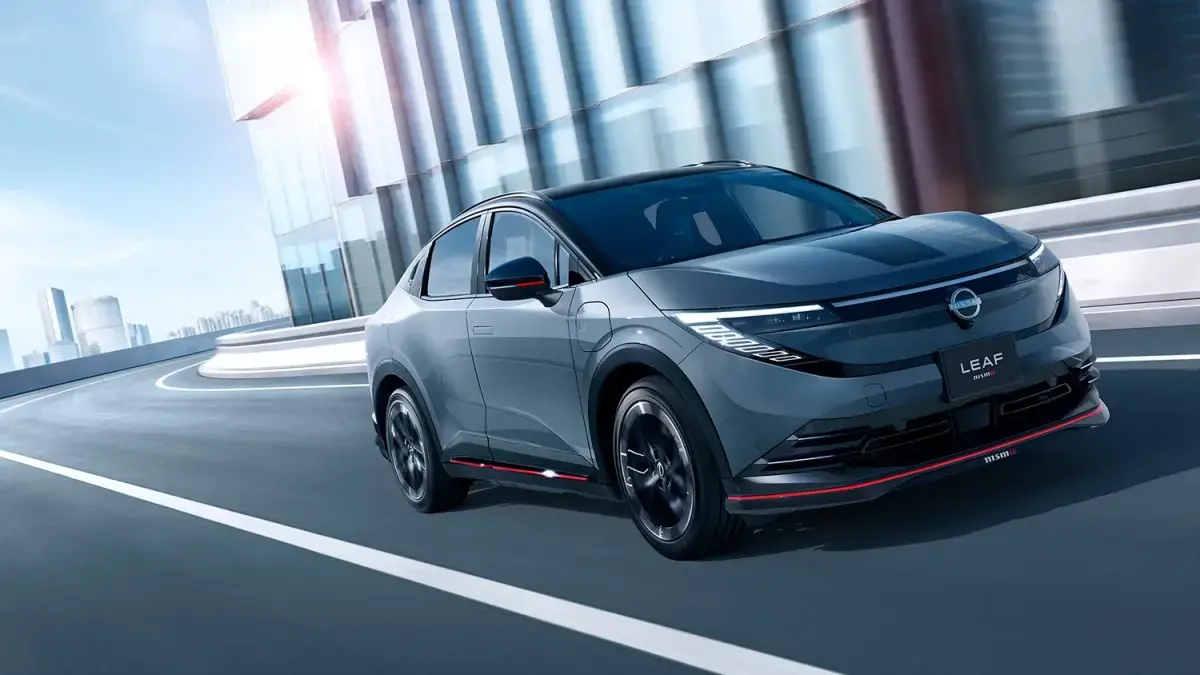
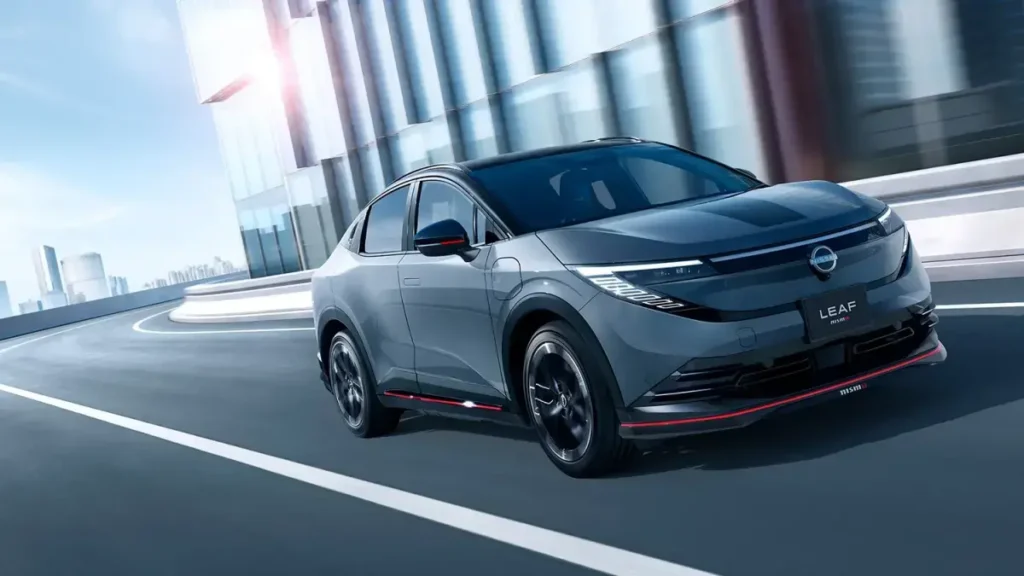
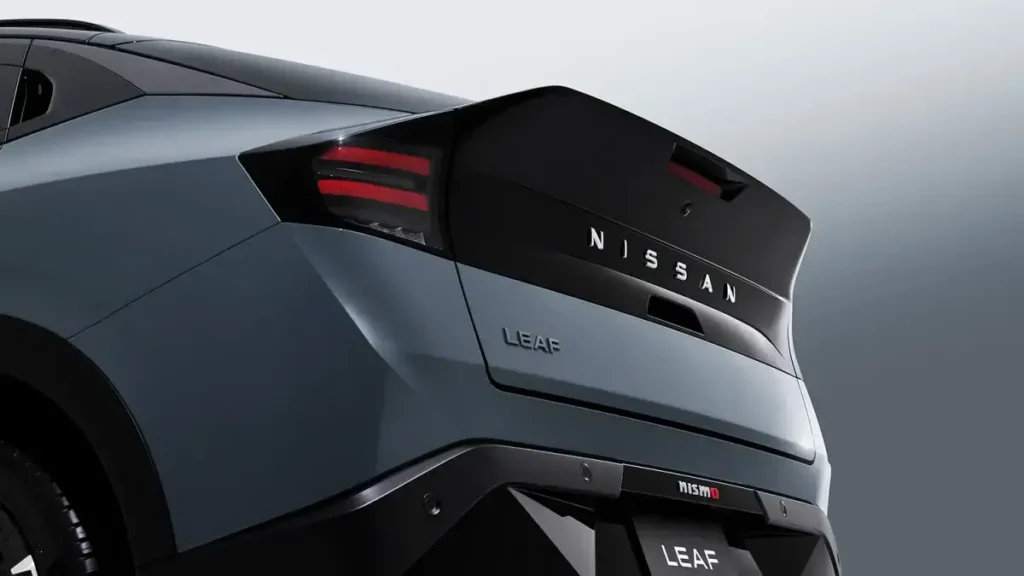
There are black surfaces, red accents, dedicated badges and a dark cabin. The front bumper, side finishers, rear diffuser-style section and extended rear spoiler make the LEAF look lower and more purposeful than the standard crossover.
But the exterior changes are not purely decorative.
Small fins at the corners of the front bumper direct air more cleanly along the sides of the body. Triangular lower-door elements use underbody pressure to reduce lift, while the extended spoiler and boat-shaped rear bumper manage airflow leaving the car. Nissan claims the complete package produces negative lift without increasing aerodynamic drag.
That last point is especially relevant for an EV.
A conventional performance body kit can improve high-speed stability while reducing efficiency. On an electric car, additional drag directly affects driving range. Nissan’s challenge was to create useful downforce without making the LEAF noticeably less effective at the job for which it was originally designed.
The result is visually restrained by NISMO standards. It looks faster, but it has not been transformed into a caricature of a touring car.
The Important Changes Begin at the Contact Patch
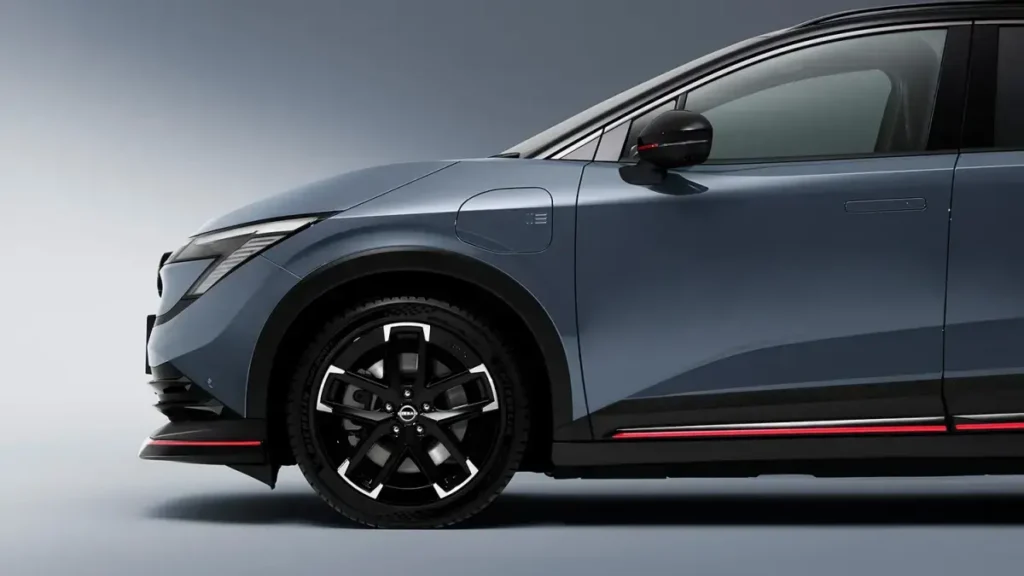
Nissan has fitted the LEAF NISMO with 235/45ZR19 Michelin Pilot Sport 5 tires mounted on 19-inch Enkei wheels.
The wheels are half an inch wider than those fitted to the corresponding standard car, yet Nissan says each one is approximately one kilogram lighter thanks to Enkei’s MAT manufacturing process. The combination is intended to improve steering response and provide stronger grip in both dry and wet conditions without ignoring rolling resistance.
This is the kind of change that rarely dominates a launch presentation but can transform how a car feels.
Electric motors already provide immediate response. Adding more output is relatively easy compared with managing the weight that comes with a large battery pack. Better tires and reduced unsprung mass can improve steering precision, braking, body control and the car’s reaction to rapid direction changes.
Nissan appears to understand that the LEAF’s greatest performance limitation was unlikely to be a shortage of instant torque.
It was the difficulty of making that torque feel connected to a responsive chassis.
NISMO Tuned the Structure Around the Battery
The suspension receives stronger front and rear springs and anti-roll bars, together with KYB dampers using swing-valve technology. Nissan says the setup is intended to suppress roll in corners and pitch over uneven surfaces while retaining a controlled, relatively flat ride.
The engineers also revised part of the front subframe bushing arrangement.
Bushings are small rubber components that isolate vibration and allow controlled movement between structural parts. They are rarely mentioned outside a detailed technical review, yet their stiffness and position can have a noticeable effect on steering response.
Nissan says the NISMO-specific tuning reduces unwanted deformation through the path connecting the steering system, suspension and front tires. The goal is a more direct relationship between steering input and the movement of the car.
These changes matter more than another software-generated burst of acceleration.
They suggest the LEAF NISMO was developed as a complete road car rather than a standard model carrying a more aggressive accelerator map.
Whether the tuning succeeds without damaging ride comfort will require an independent drive. Nissan’s description of a flat yet comfortable chassis is still a manufacturer claim, not a verified result.
The Motor Is Being Used Differently, Not Necessarily Harder
The LEAF NISMO offers NISMO, Standard and Eco driving modes, each with a dedicated acceleration profile.
Nissan says its electric control system can make adjustments in increments as small as one ten-thousandth of a second. NISMO mode sharpens initial response and emphasizes stronger acceleration, while Standard is calibrated to provide more progressive performance in everyday driving. Eco remains efficiency-focused but receives its own NISMO-specific tuning.
This is where Nissan’s approach becomes both credible and vulnerable.
Electric cars are defined by software to an unusual degree. Changing the relationship between pedal movement and motor response can make a vehicle feel significantly more alert even when peak output remains unchanged.
A sharper response, however, is not the same thing as more sustained performance.
Nissan has not published the kind of acceleration, lap-time or thermal-performance data that would establish the LEAF NISMO as a direct rival to dedicated electric performance cars. It may feel substantially more engaging on a winding road without becoming meaningfully faster in a straight line.
That distinction needs to remain clear.
The badge promises a NISMO experience. The launch material currently proves that the car received serious tuning, but not that it has entered the top tier of performance EVs.
Regenerative Braking Becomes a Driver Control
One of the most thoughtful additions is a pair of paddles that allow the driver to select between four levels of regenerative braking.
Nissan says this is the first time the feature has appeared on a NISMO model. At the lightest setting, the car coasts with relatively little resistance. At the strongest, most routine acceleration and deceleration can be controlled through the accelerator pedal alone.
On a combustion car, steering-wheel paddles usually control gears.
The LEAF has no conventional gearbox to shift, so Nissan has given the driver direct control over another part of the car’s behaviour: the rate at which it slows and recovers energy.
That is a better use of the hardware than simulated gear changes would have been.
A driver approaching a sequence of bends can increase regeneration for stronger off-throttle deceleration. On a faster, open road, a lighter setting allows the car to carry momentum. The adjustment may not create the theatre of a downshift, but it gives the driver a real mechanical consequence to manage.
Electric performance cars need new forms of interaction. Adjustable regeneration is one of the few that does not pretend an EV has a combustion engine.
The Cabin Tries to Add Focus Without Becoming Unusable
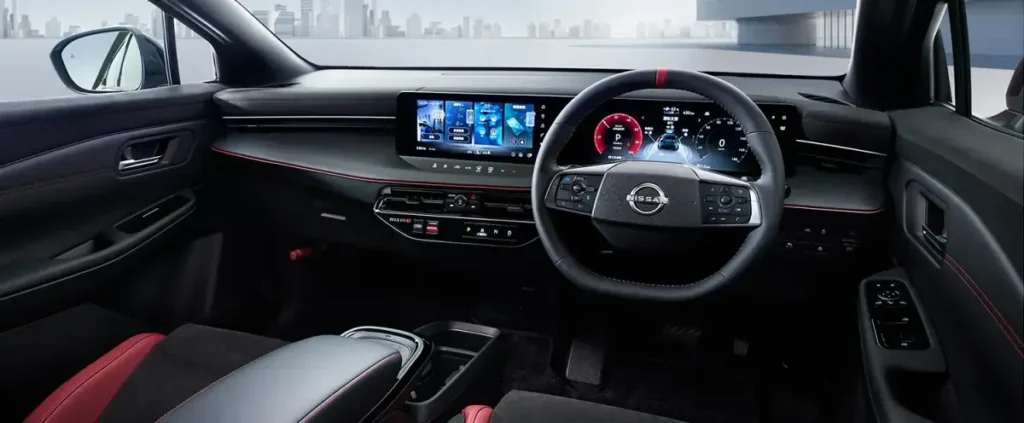
Inside, the NISMO treatment includes black materials, red detailing and a red center marker on the steering wheel.
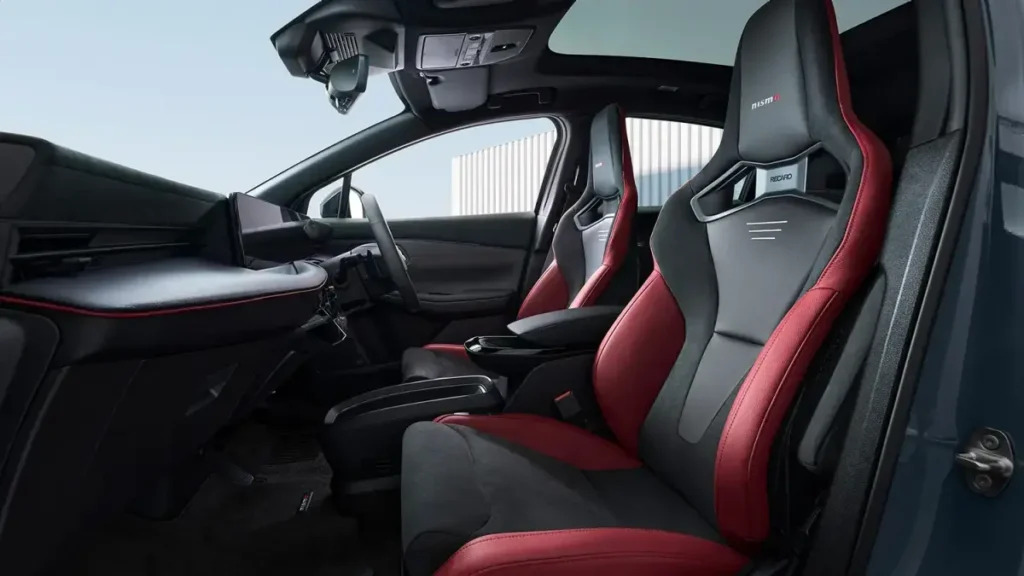
More serious buyers can specify NISMO-tuned Recaro front seats trimmed in leather and Alcantara. Nissan says the seats provide additional lateral support while retaining power reclining adjustment, preserving some of the convenience expected from an everyday crossover.
That balance reflects the entire car.
The LEAF NISMO is not a stripped-out track special. It remains a five-door electric crossover with the technology, space and refinement of the regular model.
Its mission is to add involvement without removing usefulness.
This may disappoint buyers expecting a road-going version of the dramatic dual-motor LEAF NISMO RC racing demonstrator. It also makes the production car far easier to live with.
The Price Creates the Hardest Question
At ¥6,601,100 before options, the LEAF NISMO is no longer positioned as inexpensive electric transportation. Versions equipped with additional equipment and Recaro seats move higher still in the Japanese range.
That premium changes the standard against which the car should be judged.
Better dampers, lighter wheels, premium tires, aerodynamic development and interior upgrades cost real money. The NISMO is clearly more than a sticker package.
The unresolved question is whether customers will pay performance-car money for a vehicle whose most meaningful improvements are found in feel rather than headline output.
Enthusiasts often say they value steering, balance and response more than specifications. The LEAF NISMO may test how sincere that claim really is.
Japan Gets It First – the Rest of the World Is Still Unclear
The official launch applies to Japan, where sales began immediately on July 22. Nissan has not yet detailed a wider rollout for the LEAF NISMO in its global announcement.
That limits the car’s immediate impact.
The third-generation LEAF is a global model, with production planned in Japan and the United Kingdom, but regional battery choices, charging hardware and trim structures differ. A NISMO version for Europe or North America would therefore require its own pricing and specification decisions.
Nissan should seriously consider it.
The LEAF name is recognized globally, but recognition is not the same as desire. A credible NISMO model can change the conversation around the car even among buyers who ultimately choose a standard version.
Performance derivatives do not need to generate the highest sales volume. Their value often lies in making the entire range appear more interesting.
This May Be the Right Kind of NISMO – but Nissan Still Has to Prove It
The LEAF NISMO does not attempt to overwhelm the driver with acceleration.
Instead, Nissan has worked on the points where an electric crossover can become more rewarding: the tires, unsprung mass, suspension, body control, steering response, aerodynamic balance and relationship between acceleration and regeneration.
That is a coherent engineering approach.
It is also a gamble.
Without a major power increase, the car cannot rely on a dramatic test-drive moment to justify its price. Its success will depend on subtler qualities that cannot be confirmed in a press release: steering feel, brake consistency, ride quality and whether the chassis remains composed when driven hard.
The NISMO badge should demand more than cosmetic aggression.
This LEAF appears to have received more. The final verdict now depends on whether drivers can feel the work Nissan says it has done.