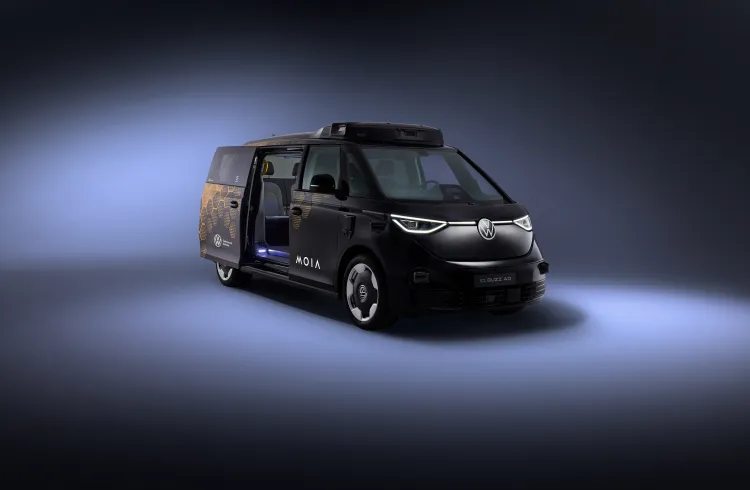
Volkswagen’s self-driving ambitions have moved beyond closed-course testing. Selected passengers in Hamburg can now book rides in an autonomous, fully electric ID. Buzz, marking one of the company’s most important real-world steps toward a commercial robotaxi service.
The passenger trial began on July 15 through MOIA, Volkswagen Group’s autonomous mobility subsidiary. Pre-registered Hamburg residents can request a ride through the MOIA app, with integration into the city’s hvv switch public transport app expected to follow.
For now, the rides are free and a safety driver remains inside the vehicle. But the significance of the trial goes far beyond the small number of vans currently operating.
From Test Vehicle to Passenger Service
Volkswagen has been developing autonomous versions of the ID. Buzz for several years, positioning the electric van as a purpose-built platform for ride-pooling, robotaxi and public transport services.
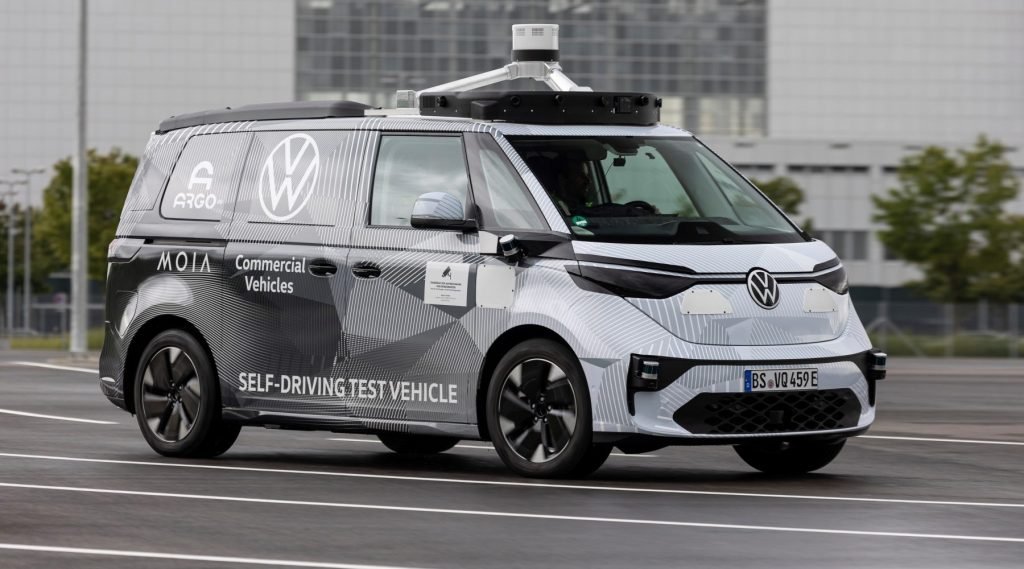
The ID. Buzz AD used in Hamburg is not simply a consumer van with additional cameras attached. It has been developed specifically for autonomous fleet operation, combining the electric vehicle platform with cameras, radar, LiDAR sensors and self-driving technology supplied with support from Mobileye.
The cabin has been designed for shared passenger use rather than private ownership. Features include dedicated passenger controls, visual guidance elements, accessibility features and connectivity to MOIA’s fleet-management platform.
During the Hamburg trial, passengers can use the app to book a ride, follow the vehicle’s arrival and travel within the designated service area. The initial operating zone covers parts of Winterhude, Barmbek and Wandsbek.
Up to ten autonomous vans are expected to participate in the test phase.
Volkswagen Is Building More Than a Robotaxi
The project represents a broader strategy from Volkswagen.
Rather than selling only autonomous vehicles, MOIA is developing a complete system that can be offered to cities, public transport operators and ride-hailing platforms. That system includes the vehicle, autonomous-driving technology, booking software, fleet management, passenger support and remote monitoring.
This could allow local transport companies to launch autonomous ride services without developing their own vehicles or software platforms.
Hamburg is particularly important because MOIA already operates a large electric ride-pooling service in the city. The autonomous vans can therefore be tested alongside an existing booking platform, transport network and customer base.
The goal is eventually to integrate autonomous vehicles into the city’s wider public transport system rather than operate them only as premium private taxis.
A Safety Driver Is Still On Board
Despite the “self-driving” description, the current passenger service is not yet completely driverless.
A trained safety driver remains inside each vehicle and can intervene when necessary. The vehicles also operate only within approved areas and under controlled conditions.
That means the Hamburg launch should be viewed as an advanced passenger trial rather than a fully commercial autonomous service.
Even so, carrying members of the public is a meaningful step. Autonomous vehicle programs often spend years collecting data with engineers and test drivers before allowing regular passengers to book rides through a public-facing app.
The trial will allow MOIA to study how passengers interact with the vehicles, how the vans perform in everyday urban traffic and how autonomous ride-pooling can connect with existing bus and rail services.
Los Angeles Is Next
Volkswagen’s autonomous plans extend beyond Germany.
MOIA and Uber have already announced plans to introduce autonomous ID. Buzz vehicles in Los Angeles. Road validation is underway, with passenger services through the Uber platform planned to begin by the end of 2026, subject to regulatory approval.
The partnership gives Volkswagen access to Uber’s large customer base while allowing Uber to add another autonomous vehicle supplier to its growing network of robotaxi partners.
Volkswagen ultimately wants to deploy autonomous fleets across multiple cities in Europe and the United States.
The Robotaxi Race Is Becoming More Crowded
Waymo remains the most established operator of commercial driverless taxi services in the United States, while Tesla continues to develop its own robotaxi platform. Companies including Hyundai, Amazon-owned Zoox, WeRide and several Chinese manufacturers are also expanding autonomous vehicle trials.
Volkswagen’s advantage may be its ability to combine large-scale vehicle manufacturing with an existing European mobility service.
The ID. Buzz is also naturally suited to shared transportation. Its tall roof, sliding doors and flexible passenger space make it easier to use as a shuttle than many conventional passenger cars adapted for autonomous driving.
Still, the difficult part will not be building a handful of capable vehicles. Volkswagen must demonstrate that the service can operate safely, reliably and economically across large urban fleets.
A Small Trial With Major Implications
Only a limited group of Hamburg residents can currently book the autonomous ID. Buzz, and every vehicle still carries a safety driver. A fully driverless citywide service remains some distance away.
But this is no longer a futuristic concept displayed at an auto show.
Volkswagen’s autonomous electric vans are now carrying passengers through real streets, booked through a real mobility app and operating as part of a real urban transport experiment.
For the ID. Buzz, the Hamburg trial may prove more important than any conventional model update. It is the first serious demonstration of how Volkswagen intends to transform the retro-styled electric van into the foundation of a global autonomous mobility business.