The revised GSX-R1000R is faster than most riders will ever need, harder to justify than ever — and more meaningful because Suzuki built it anyway.
Source and market context: Suzuki set the Japanese launch for 17 July 2026 and listed a ¥2,376,000 price including 10% consumption tax, excluding insurance, registration and other charges. Its 300-unit annual target applies to Japan, not worldwide sales. Suzuki’s 2 July 2026 Japanese launch announcement.
The rational case for a 190 PS superbike is not particularly strong.
A modern litre-class motorcycle is expensive, uncomfortable in traffic, demanding to insure and capable of reaching speeds that have no responsible place on a public road. Adventure bikes are easier to live with. Middleweights are easier to ride. Naked bikes deliver most of the excitement with fewer compromises.
Emissions and noise regulations make high-revving engines increasingly difficult to develop, while global motorcycle sales have shifted toward practical machines with broader appeal.
Suzuki could have quietly allowed the GSX-R1000R to disappear.
Instead, the company revised its engine, strengthened its internals, expanded its electronics package and placed the updated motorcycle back on sale in Japan on July 17.
The new GSX-R1000R costs ¥2,376,000. Suzuki expects to sell only 300 examples a year in its home market.
That modest target is not evidence that the motorcycle is irrelevant.
It explains why the motorcycle matters.
Suzuki Chose Engineering Over a Farewell Edition
The easiest way to celebrate the GSX-R’s 40-year history would have been to apply heritage paintwork to an existing motorcycle, add a numbered badge and call it a final edition.
Suzuki has done more than that.
The 999cc inline-four has received substantial internal revisions. The company changed the fuel injectors, cylinder head, intake and exhaust ports, camshafts, valves, pistons, crankshaft, cam chain and lubrication system.
The goal was not simply to meet newer emissions and noise regulations. Suzuki also wanted to preserve the high-rpm character expected from a GSX-R while improving durability.
In Japanese specification, the engine produces 190 PS at 13,200 rpm and 108 Nm of torque at 11,000 rpm. The motorcycle weighs 203 kilograms ready to ride.
Those figures place the GSX-R1000R firmly inside the modern superbike arms race, even if Suzuki is no longer trying to win that race through headline numbers alone.
The more significant achievement is that the engine still exists.
Keeping an Inline-Four Alive in 2026
High-revving four-cylinder engines are becoming increasingly difficult to reconcile with modern regulation.
Noise must be controlled. Exhaust emissions must be reduced. Durability expectations are higher, and the motorcycle still has to deliver the immediate throttle response and top-end performance that define the category.
Suzuki increased the compression ratio, reshaped the forged pistons, strengthened the crankshaft and redesigned parts of the intake, exhaust and lubrication systems. A lighter lithium-ion battery helps offset some of the added complexity.
The clutch was also revised to offer lighter operation and smoother downshifts.
Much of that work will be invisible to the owner.
That is precisely why it deserves attention.
The updated GSX-R1000R is not a styling exercise built around anniversary graphics. It is the result of engineers doing the difficult, expensive work required to keep a particular type of motorcycle viable.
The rules changed. Suzuki changed the motorcycle rather than abandoning the idea behind it.
Electronics Without Losing the Mechanical Center
The GSX-R1000R is no analogue throwback.
Suzuki’s Intelligent Ride System combines traction control, front-wheel-lift management and roll-torque control. The motorcycle also receives launch control, a bidirectional quickshifter, cornering-sensitive brake assistance, downhill rear-wheel-lift mitigation and several power-delivery settings.
These systems are necessary on a motorcycle with this level of performance.
The important question is whether the electronics support the riding experience or become the experience.
Suzuki has kept the engine and chassis at the center of the motorcycle. The electronic systems exist to make the performance more usable, more repeatable and less intimidating. They do not attempt to disguise the fact that the GSX-R1000R remains a focused, physically demanding machine.
Optional carbon-fiber winglets provide additional downforce at high speed and help limit front-wheel lift under acceleration. They are functional additions rather than decorative imitations of MotoGP hardware.
Even with the added technology, the GSX-R remains visually recognizable. Suzuki has updated the motorcycle without turning it into a rolling collection of aerodynamic experiments.
The Paintwork Looks Back. The Engineering Moves Forward.
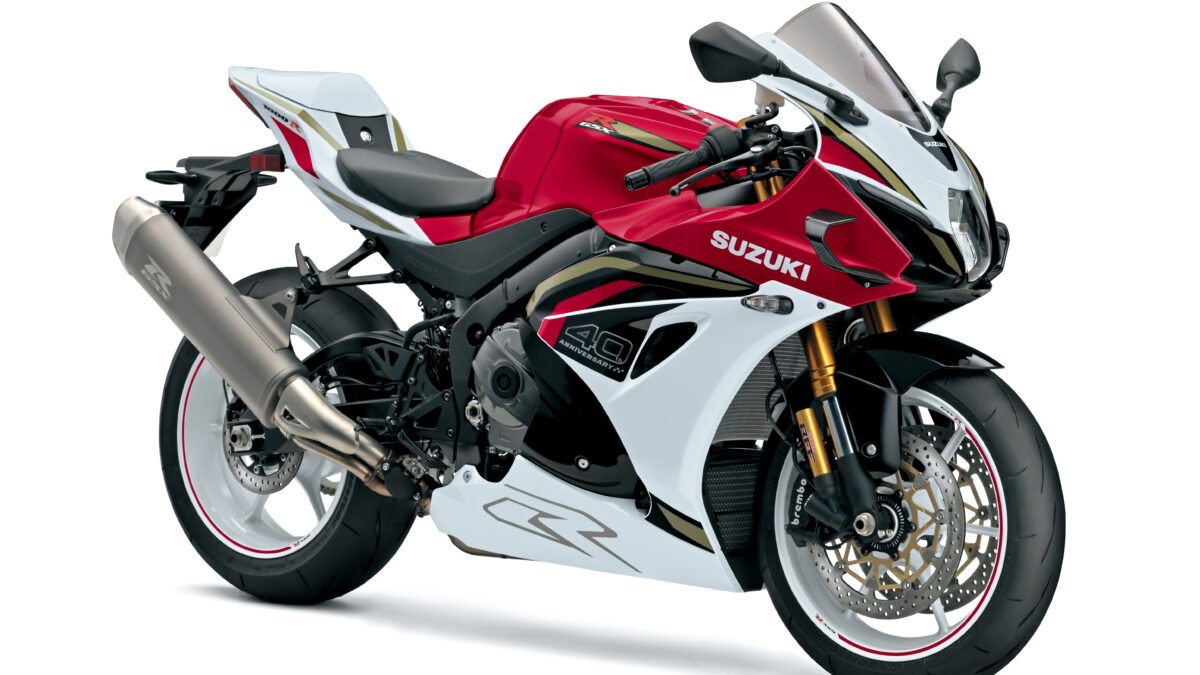
The launch colors deliberately reference Suzuki’s racing history.
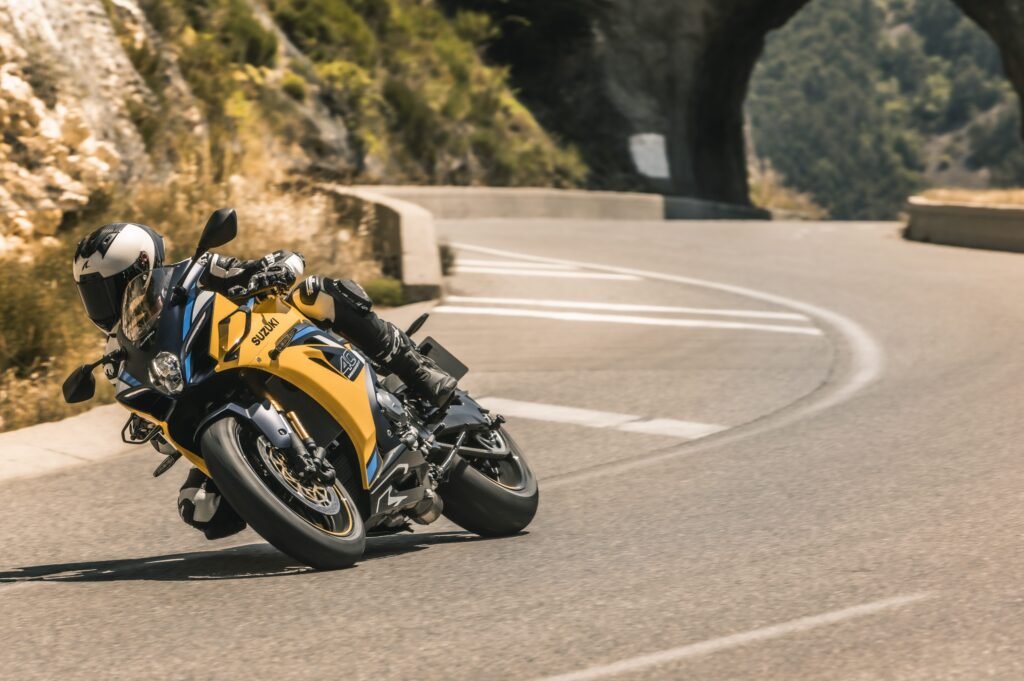
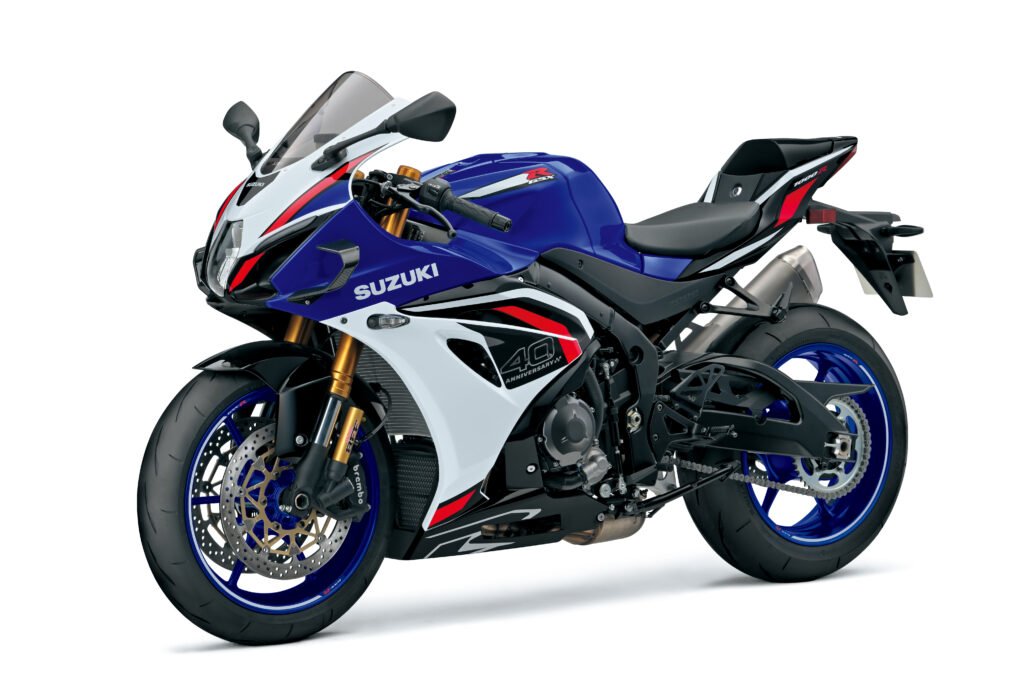
Buyers can choose the familiar blue-and-white scheme, a red-and-white version or a vivid yellow-and-dark-blue combination. Each carries 40th-anniversary graphics.
Heritage paint can be powerful, but it can also become an excuse.
Motorcycle manufacturers know that nostalgia sells. A famous color scheme can generate attention even when the machinery underneath has barely changed.
The GSX-R1000R avoids that trap because the anniversary treatment sits on top of genuine engineering work.
The colors connect the new motorcycle to the original GSX-R philosophy: high performance, low weight and a direct relationship between rider and machine. The revised engine and electronics make that philosophy possible under current regulations.
Suzuki is not asking buyers to celebrate what the GSX-R used to be.
It is giving them a new motorcycle that still understands why the name became important.
Three Hundred Motorcycles Can Still Matter
An annual Japanese sales target of 300 units is tiny compared with the volumes generated by scooters, commuters and middleweight adventure bikes.
The GSX-R1000R performs a different role.
It serves as Suzuki’s mechanical flagship. It keeps the company connected to racing culture and gives the rest of the motorcycle range a performance reference point.
A manufacturer can sell thousands of practical machines and still need one motorcycle that communicates ambition.
That value does not appear neatly in unit-sales reports.
Halo products influence how customers view an entire brand. They create showroom traffic, strengthen loyalty and remind riders that engineering decisions are not always made by accountants alone.
Suzuki is unlikely to make the GSX-R1000R the center of its business again.
It does not have to.
The motorcycle only needs to prove that the company still understands how to build one.
The Superbike Has Become a Choice, Not an Obligation
There was a time when every major Japanese manufacturer needed a litre-class superbike at the top of its range. Today, the segment is smaller, more specialized and far more difficult to justify.
That makes the updated GSX-R1000R more interesting than it would have been during the superbike boom.
Suzuki is no longer building this motorcycle because the market demands it. The company is building it because the GSX-R remains an important part of its technical and cultural identity.
The result is not a revolution. It does not redefine the category or make the litre-class superbike practical.
It does something more honest.
It accepts that motorcycles like this are irrational and gives riders a carefully engineered reason to desire one anyway.
The superbike may no longer sit at the center of the motorcycle market.
Suzuki has made a convincing case that it still deserves a place in the world.
For the engineering changes and equipment, see Suzuki’s 2026 GSX-R1000R product guide. Equipment and specifications can vary by market.
Related reading
Explore more motorcycle coverage. For the same question of driver involvement at a very different scale, read our Zenvo Aurora analysis.