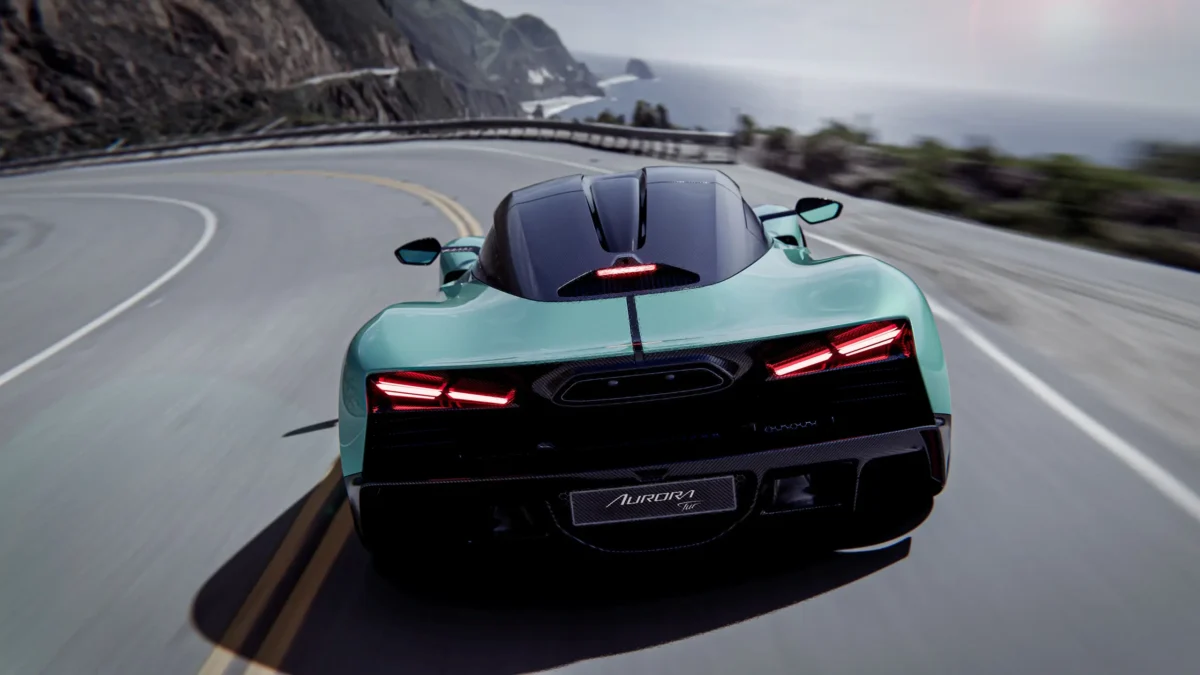
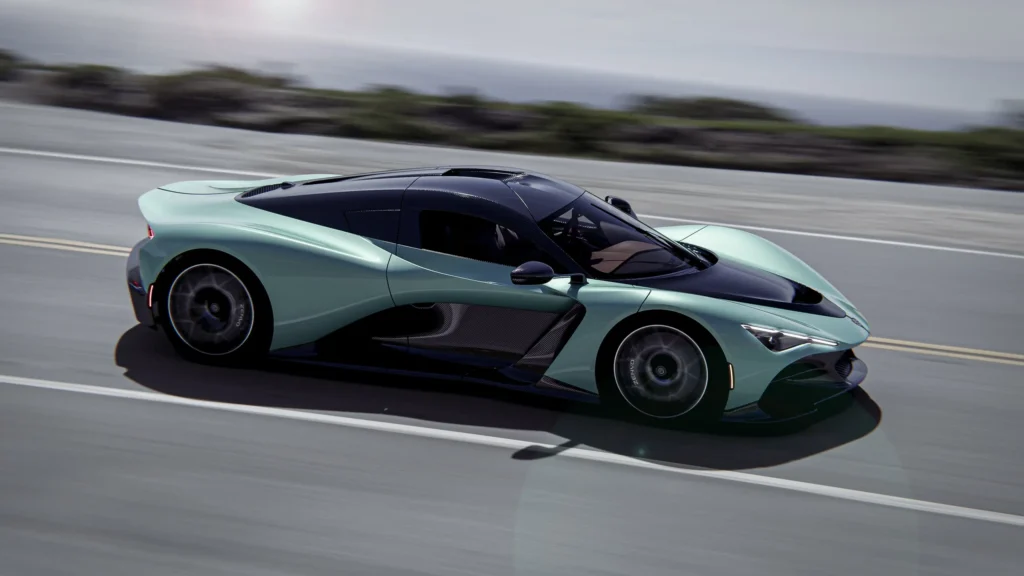
The Aurora has a quad-turbo V12, hybrid assistance and a projected 260-mph top speed. Zenvo would rather talk about steering feel.
The modern hypercar has become a machine for producing numbers.
Horsepower rises. Acceleration times fall. Top-speed claims approach figures that cannot be explored on a road and may never be independently verified. Each new arrival is expected to outperform the last before anyone has driven it.
Zenvo’s Aurora appears perfectly equipped to participate.
Its bespoke 6.6-litre V12 uses four turbochargers, produces 1,250 bhp without electrical assistance and revs to 9,800 rpm. Electric motors raise combined output to as much as 1,850 bhp in the road-focused Aurora Tur. Zenvo estimates a top speed of 420 km/h, or 260 mph.
Then the Danish company does something unexpected.
It asks us not to concentrate on the numbers.
Zenvo executive chairman Jens Sverdrup says performance figures are a consequence of the engineering rather than its purpose. His priorities are sound, vibration, throttle response, steering precision and the feeling that the driver remains physically connected to the machine.
That is either a refreshing change of philosophy or an extraordinarily ambitious contradiction.
Possibly both.
Two Auroras, One Complicated Mission
Zenvo will produce the Aurora in two versions.
The Tur is the road and grand-touring model. It combines the V12 with three electric motors for all-wheel drive, torque vectoring and the full estimated 1,850 bhp. It weighs a claimed 1,548 kilograms and is intended to provide stability and comfort at road speeds as well as extreme performance when conditions allow.
The Agil is the more focused interpretation.
It removes the two front electric motors, lowering estimated output to 1,450 bhp and weight to 1,360 kilograms. Active underbody aerodynamics and a large rear wing are claimed to produce 800 kilograms of downforce at 250 km/h. Its top speed is electronically limited to 360 km/h because the car is designed around circuit performance rather than the pursuit of a maximum figure.
Only 50 examples of each version are planned.
The two-model strategy allows Zenvo to answer a problem that has troubled high-performance cars for decades.
Should a hypercar be a devastating track machine or an extraordinary road car?
Zenvo’s answer is to build both without pretending that one setup can perform each role perfectly.
The Engine Is Almost Absurd
The Aurora’s V12, named Mjølner, was developed with MAHLE Powertrain specifically for the car.
It is a 90-degree, hot-V design, placing the turbochargers between the cylinder banks to reduce the distance exhaust gases travel before reaching them. The engine uses electrically controlled variable-geometry turbochargers and pre-heated catalytic converters intended to combine response with emissions compliance.
The combustion engine alone produces more power than many hybrid hypercars manage with their entire powertrains.
Yet the most unusual figure may be the 9,800-rpm limit.
Turbocharged engines often trade the theatrical climb toward a redline for enormous mid-range torque. Zenvo is attempting to provide both: the violent acceleration of forced induction and the escalating drama of a naturally aspirated exotic engine.
The eight-speed transmission is hybridised, with an electric motor integrated into the drivetrain. Zenvo estimates that the Tur will reach 100 km/h in 2.3 seconds and 400 km/h in approximately 17 seconds.
None of this sounds restrained.
The restraint has to come from how the technology is presented to the driver.
Zenvo’s Benchmarks Are Telling
When discussing the Aurora, Sverdrup does not primarily point to Bugatti, Koenigsegg or the latest Nürburgring record holder.
He mentions the original Honda NSX, the McLaren 675LT and lightweight Lotus models from the 1960s.
Those cars are not linked by output or price.
They are remembered because their controls communicate clearly and their performance feels accessible before the driver reaches an irresponsible speed.
That is the quality Zenvo is trying to preserve inside a machine with nearly 2,000 horsepower.
Hydraulic steering is central to the effort. While most modern performance cars use electrically assisted systems, Zenvo believes hydraulic assistance provides a more fluid and organic connection between the front tyres and the driver’s hands.
This is where the Aurora’s claim becomes genuinely interesting.
It is relatively easy to describe a lightweight sports car as analogue. It is much harder to make a hybrid, all-wheel-drive, quad-turbo hypercar feel unfiltered.
Complexity Is the Enemy Zenvo Chose
The Aurora contains almost every technology capable of separating a driver from a road.
Multiple electric motors manage torque. Active aerodynamics alter the airflow. Turbochargers control the engine’s breathing. Hybrid hardware adds power and weight. Software must coordinate everything without making its presence obvious.
Zenvo’s task is therefore not to eliminate complexity.
It is to hide the bureaucracy of complexity while allowing the useful parts to remain.
The carbon-composite ZM1 monocoque weighs a claimed 120 kilograms, and approximately 70 percent of the structure remains visible. Zenvo describes the chassis as both an engineering component and part of the car’s visual design.
That exposed construction is more than theatre.
It communicates the company’s broader idea: the driver should be able to understand the machine, even when the technology operating beneath the surface is extraordinarily sophisticated.
A Hypercar Should Work Below 200 MPH
Sverdrup argues that chasing records can compromise the way a car behaves at ordinary speeds.
A setup designed around maximum downforce, top-speed stability or a single lap time can become frustrating on a narrow road. Heavy steering may feel impressive on a circuit and exhausting in traffic. Abrupt power delivery may produce a dramatic acceleration figure while making the car unpleasant to use.
Zenvo wants the Aurora to remain enjoyable in those less glamorous moments.
Ease of entry, cabin usability and Scandinavian restraint were considered alongside performance. The Tur, in particular, is intended to function as a real grand tourer rather than a racing prototype with number plates.
That may sound like a modest objective until the power figure returns to mind.
Making an 1,850-bhp car manageable in traffic is arguably a more difficult achievement than making it fast on an empty runway.
Zenvo Is Searching for Its Identity
Every established hypercar manufacturer owns a recognisable piece of the market.
Bugatti represents effortless speed and engineering grandeur. Pagani combines sculpture with mechanical theatre. Koenigsegg pursues invention and records. Gordon Murray Automotive focuses intensely on low weight and driver involvement.
Zenvo needs a similarly clear reason to exist.
The Aurora is its attempt to define one.
The company is combining Danish design, an extravagant powertrain and a stated commitment to analogue feedback. It is trying to occupy the space between the record-breaking monsters and the lighter, purist machines.
That position is not guaranteed.
A car cannot be declared engaging through a press release. No specification can prove steering feel, and no simulation can tell us whether the powertrain feels harmonious rather than chaotic.
Zenvo will have to demonstrate all of it from behind the wheel.
The Numbers Still Matter — Just Not in the Usual Way
The Aurora’s specifications are impossible to ignore.
An 1,850-bhp V12 hybrid that can theoretically approach 260 mph is not a rejection of the hypercar numbers race. It is one of its most extreme participants.
The difference lies in what Zenvo believes those numbers should serve.
Power should intensify the experience rather than replace it. Technology should make the car more responsive rather than merely more measurable. Speed should be exciting because the driver feels involved, not because a data logger records an extraordinary result.
That is a difficult promise to keep.
It is also far more compelling than another manufacturer claiming to have won a race that can only be experienced on a spreadsheet.