Honda’s latest update to its tiny kei car is deliberately modest. That may be exactly why the N-BOX remains so successful.
A 660cc engine, a tall body and a footprint designed for crowded Japanese streets do not sound like the ingredients of an industry-defining car.
Yet the Honda N-BOX has achieved something most global models never will. By April 2026, cumulative sales of the N-BOX family had passed three million units. It has led Japan’s entire new-car market for five consecutive years and the kei-car category for 11 years running.
Honda’s latest update, which went on sale in Japan on July 17, does not radically alter that formula. There is no new electric platform, no dramatic power increase and no dashboard dominated by an oversized display.
Instead, Honda has adjusted the styling, expanded the range of personalities and added small conveniences that owners are likely to use every day.
It is an unusually restrained launch in an industry addicted to reinvention. It is also a useful reminder that successful cars are often improved by understanding them, not replacing them.
A Bestseller Honda Does Not Need to Reinvent
The updated N-BOX remains instantly recognizable.
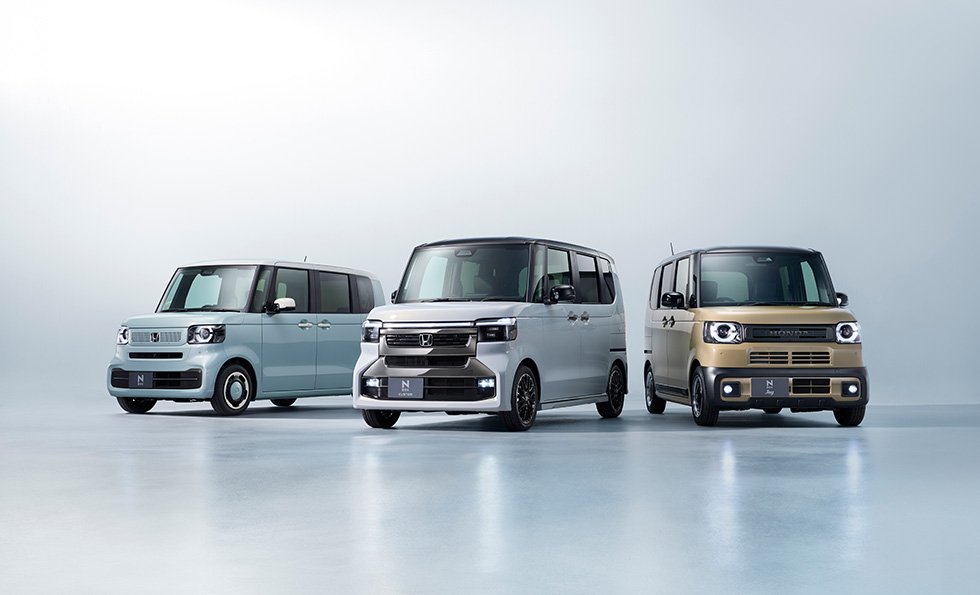
The standard model receives subtle chrome details and a revised finish, while the Fashion Style continues to use contrasting white elements on the roof, mirrors, door handles and wheel covers.
The N-BOX Custom moves in a more assertive direction. A larger chrome grille, horizontal lighting details and squared-off fog lamps give it a heavier visual presence than its dimensions would suggest.
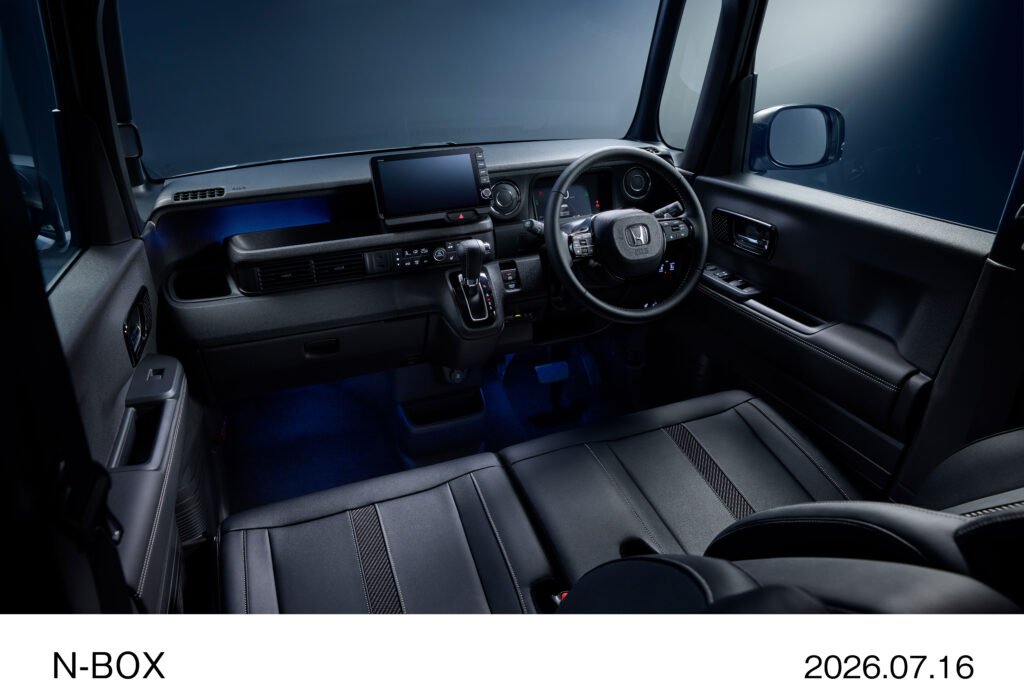
The N-BOX Joy, meanwhile, plays the lifestyle role. Its round fog lamps, prominent HONDA lettering and outdoor-inspired details are intended to give the car a more recreational character. A new Black Style version adds dark exterior trim, black badges, check-pattern seats and amber interior lighting.
These changes are largely cosmetic, but that does not make them unimportant.
Honda has built several distinct identities around the same practical body. A buyer can choose a simple family car, a more premium-looking Custom or a playful Joy without giving up the packaging that made the N-BOX popular in the first place.
That is a more sophisticated strategy than merely offering different colors.
Honda is allowing customers to express taste without forcing them into a larger, heavier or less practical vehicle.
The Appeal Is in the Packaging
The N-BOX succeeds because it uses a small amount of road space exceptionally well.
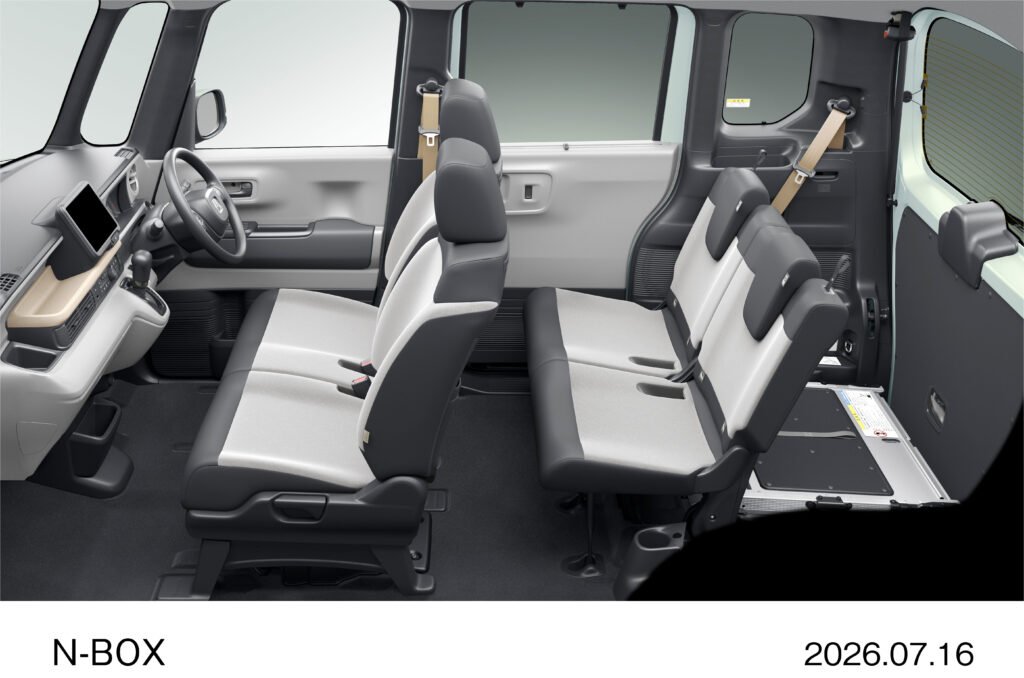
Its upright proportions create a cabin that feels larger than the exterior suggests. The tall roof, wide-opening doors and low floor make it easier to load children, shopping, luggage and mobility equipment.
Honda has also resisted the temptation to turn the interior into a technology demonstration.
Every version now includes two USB-C ports in the center of the cabin, along with additional storage behind the front seats. Depending on specification, buyers can add a nine-inch Honda Connect navigation system, a multi-view camera, heated steering wheel, leather-wrapped controls and LED interior lighting.
None of these features is revolutionary. Together, they address the small frustrations that shape daily ownership.
That distinction matters.
Many new cars are designed to impress during a ten-minute showroom visit. The N-BOX appears to have been designed around the tenth month of ownership, when the novelty has disappeared and usability becomes the only thing that matters.
Accessibility Is Part of the Product, Not an Afterthought
Honda also continues to offer N-BOX and N-BOX Custom models equipped with a rear wheelchair ramp.
The updated accessible versions include details such as a standard driver’s-seat height adjuster and improved rear lighting on the Custom model.
These variants are not presented as separate specialist vehicles disconnected from the main range. They remain visually and functionally part of the N-BOX family.
That says something important about the way Honda approaches the car.
The N-BOX is designed around a broad definition of mobility. It needs to work for parents, older passengers, city residents, wheelchair users and people who simply want to carry more than the exterior dimensions appear to allow.
The industry often discusses accessibility as a future challenge. Honda has integrated it into one of its most successful current products.
Small Does Not Mean Cheap
The N-BOX also demonstrates that compact cars do not have to occupy the bottom of the market.
In Japan, the front-wheel-drive standard model begins at ¥1,768,800. The N-BOX Custom starts at ¥1,994,300, while the N-BOX Joy begins at ¥1,981,100. Higher-specification turbocharged and four-wheel-drive versions can climb beyond ¥2.7 million.
That is a wide price range for a kei car.
Honda is not selling the N-BOX purely as low-cost transportation. It is selling it as a complete model family, with entry-level, lifestyle and premium variants built around the same compact footprint.
This runs against a common industry assumption: that customers who spend more should automatically move into a larger vehicle.
The N-BOX offers another possibility. A buyer can spend more on better materials, equipment, styling and convenience while keeping the same efficient dimensions.
In cities where parking space and road width are genuine constraints, that approach makes far more sense than upsizing for the sake of status.
A Japanese Solution With a Global Lesson
The N-BOX is closely tied to Japan’s kei-car regulations, tax structure and urban environment. It cannot simply be exported to every market and expected to achieve the same result.
Its broader philosophy, however, is highly transferable.
Much of the global automotive industry has allowed entry-level cars to disappear while simultaneously making mainstream vehicles larger and more expensive. Features have increased, but so have weight, complexity and purchase prices.
The N-BOX proves that customers will pay for a small car when small does not feel synonymous with basic.
Its success is built on packaging, ease of use, visibility, accessibility and customization. Those qualities are less dramatic than acceleration figures or battery range, but they affect every journey.
Honda has turned compactness into a feature rather than an apology.
The Update Is Modest Because the Original Idea Still Works
The refreshed N-BOX will not dominate international motor shows. It will not become a poster car, a track-day favorite or the centerpiece of Honda’s global technology strategy.
It does not need to.
Its importance lies in the fact that millions of buyers have chosen it for ordinary life, and Honda has resisted the urge to disrupt a formula that continues to work.
The company has refined the design, broadened the range and improved the details without confusing change with progress.
At a time when carmakers are spending enormous sums trying to predict what drivers may want in the future, the N-BOX succeeds by paying close attention to what people need today.
That may be the most modern thing about it.